
When a longtime home needs some updating, it can be hard to know what’s worth fixing and what’s better left alone. Before you start spending money, take a step back and look at the bigger picture.

When you’re preparing a longtime home for sale, it’s incredibly easy to walk from room to room and start making a list.
The carpet is old.
The kitchen is dated.
That bedroom needs paint.
The deck could use some attention.
The bathroom hasn’t been remodeled in years.
Pretty soon, a home sale has turned into a renovation project.
There will almost always be something that could be improved.
The better question is:
What, if anything, is actually worth doing before this particular home goes on the market?
That answer depends on the property, the market, your timeline, your goals and the amount of work you’re willing or able to take on.
This may feel backward.
Shouldn’t you get the house fixed up before asking a Realtor to come over?
Usually, we’d rather see it first.
An experienced Realtor can look at the home through the eyes of today’s buyers and help you distinguish between:
Things buyers are likely to care about
and
Things you’re noticing because you’ve lived with the house for years.
Those aren’t always the same list.
Getting perspective early can help prevent you from spending money on improvements that don’t meaningfully change the home’s marketability or likely selling price.
There’s a difference between something that isn’t working properly and something that’s simply dated.
A leaking pipe and an older kitchen countertop aren’t the same kind of issue.
Understanding the difference can help you prioritize.
Some issues can immediately affect a buyer’s impression of the home.
Others may barely register.
The goal isn’t to make the home perfect. It’s to understand which things are most likely to influence how buyers perceive the property.
Spending $5,000 on a project doesn’t automatically add $5,000—or more—to the home’s value.
Some improvements can help a home show or sell better. Others may simply move money from one pocket to another.
Before investing, consider both the financial cost and the time required.
This one matters enormously during a move to assisted living.
A project may technically make sense from a real estate perspective and still not make sense for you.
If completing it delays the sale significantly, requires family members to coordinate weeks of work, or adds more stress to an already difficult transition, that belongs in the decision too.
The best real estate decision isn’t always the one that produces the most perfectly prepared house.
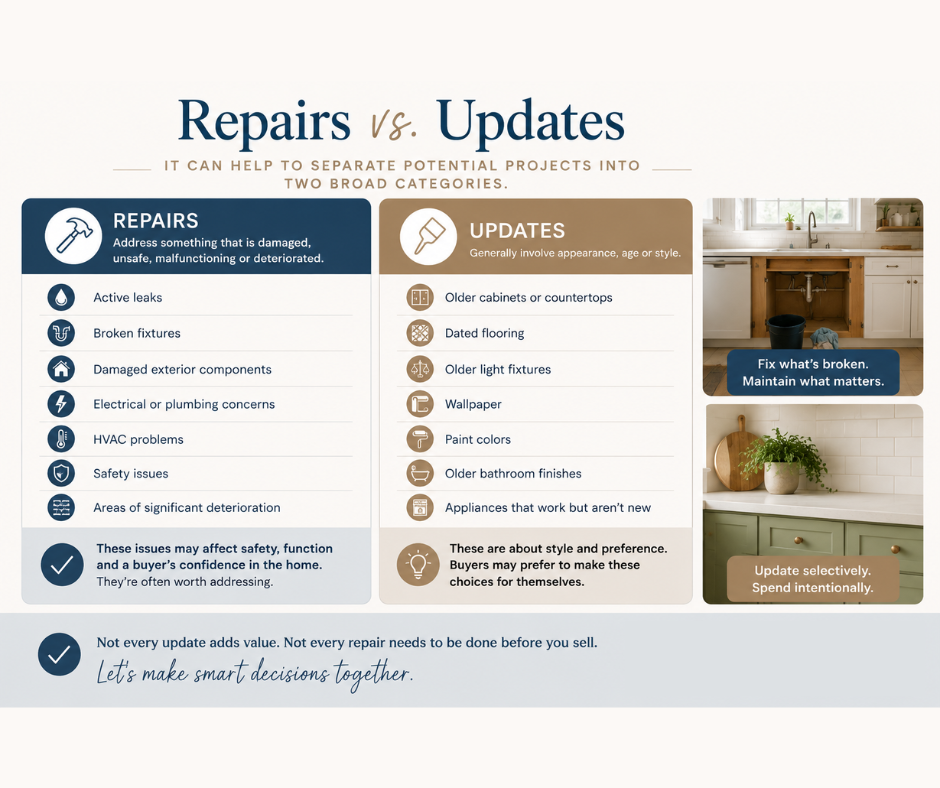
It can help to separate potential projects into two broad categories.
These address something that is damaged, unsafe, malfunctioning or deteriorated.
Examples might include:
Whether these should be repaired before listing still depends on the situation, but they’re worth identifying.
These generally involve appearance, age or style.
Examples might include:
A home does not necessarily need to look new to sell.
And buyers may prefer to make their own cosmetic choices rather than pay more for updates they wouldn’t have selected themselves.
There are plenty of “rules” about preparing a house for sale.
Reality is more nuanced.
Maybe.
Fresh paint can make a meaningful difference in some homes. In others, painting every room may be unnecessary.
Not always.
Condition, price point and what lies underneath can all matter.
A full kitchen remodel immediately before selling is a major investment.
Before taking that on, understand whether the market is actually likely to reward it.
If the existing appliances function, replacement isn’t automatically necessary simply because they’re older.
First impressions matter, but that doesn’t mean you need a professional landscape overhaul.
Sometimes basic maintenance and cleanup accomplish what you need.
It’s to make good decisions about where your time, money and energy will matter.
During a major life transition, all three are valuable.
A home can be well positioned for the market without being completely remodeled.
That’s a legitimate conversation to have.
Depending on the home and your circumstances, selling in its current condition may be an option.
That doesn’t automatically mean it’s the best choice—and it doesn’t automatically mean you’ll have to fix everything either.
There are tradeoffs involving:
The important thing is to understand those tradeoffs before deciding.
Once you’ve determined that a repair or project actually makes sense, the next question is often:
Who do we call?
That’s another area where having an experienced local Realtor can help.
After more than 20 years in Greater Peoria real estate, Jana has built relationships with local professionals and service providers and may be able to point you toward resources when they’re needed.
The key is the order:
First decide what actually makes sense. Then find the right person to help with it.
Not the other way around.
Does something actually need to be repaired—or is it simply older?
Is this likely to matter to buyers in this home’s market?
What will it cost?
How long will it take?
Could it delay our selling timeline?
How much coordination will it require?
Are we likely to recover enough benefit to justify it?
What happens if we simply don’t do it?
You don’t need perfect answers to every question.
But asking them can help you avoid turning a home sale into an unnecessary renovation.

A good Realtor shouldn’t automatically hand you a list of projects.
The goal is to help you make decisions that fit the home and your circumstances.
That might mean identifying something worth repairing.
It might mean making a few inexpensive improvements.
It might mean connecting you with a contractor.
And sometimes, it might mean telling you that the project you’re considering probably isn’t where your money or energy needs to go.
That’s why it’s worth having the conversation before the work begins.
If you’re looking at the project list and thinking you’d rather avoid repairs altogether, the next step is understanding what selling a home “as-is” actually means.
It may be an option—but it’s worth understanding the tradeoffs first.
You don’t need to fix everything before you call us.
You don’t even need to know what needs fixing.
Let us see the home as it is, understand what’s happening, and help you think through which projects may be worth considering—and which ones may not be.
No pressure to list. No renovation checklist waiting for you.
Just practical guidance about the home and what might make sense next.