
Sometimes the thought of making repairs, updating rooms and preparing a longtime home for market feels like too much. Selling as-is may be an option—but it’s important to understand what that really means before you decide.

People sometimes hear “as-is” and picture a property with major problems.
That’s not necessarily the case.
A home might be sold in its current condition simply because the seller doesn’t want—or isn’t in a position—to take on repairs or improvements before selling.
For someone moving to assisted living, that may be particularly important.
The home may need updating.
There may be some repairs.
Or the family may simply decide that coordinating projects isn’t the best use of their time, money and energy during an already complicated transition.
It’s not a judgment about the home.
In general, selling a home as-is means the seller is offering the property in its current condition rather than planning to make repairs or improvements as part of preparing it for sale.
But there’s an important distinction:
A buyer may still choose to inspect the property.
It also doesn’t automatically eliminate disclosures, contractual obligations or other requirements that may apply to the transaction.
The exact terms of an as-is sale matter.
That’s why it’s important to understand the contract and your specific situation rather than relying on the phrase alone.
Selling as-is doesn’t automatically remove disclosure obligations that otherwise apply.
Inspection rights depend on the contract. An as-is sale and a sale with no inspection are not necessarily the same thing.
There are buyers who are comfortable purchasing homes that need updating or work.
The home’s condition simply becomes part of the overall pricing and marketing strategy.
As-is doesn’t mean giving the property away.
The home still needs to be evaluated in the context of its location, condition, features and current market.
As-is doesn’t mean you aren’t allowed to clean, remove belongings, improve curb appeal or take other reasonable preparation steps.
It simply means we need to decide intentionally what makes sense.
The financial outcome matters.
But it’s not the only thing that matters.
Consider what a renovation or repair plan might require:
Finding contractors.
Getting estimates.
Scheduling work.
Waiting for materials.
Making decisions.
Paying invoices.
Checking progress.
Possibly traveling back and forth.
Delaying the listing.
For some families, that work is worthwhile.
For others, the ability to simplify the transition may have real value.
The question isn’t simply:
“Could we make more money if we fixed things?”
It’s:
“After considering the cost, time, work and likely outcome, which option makes the most sense for us?”
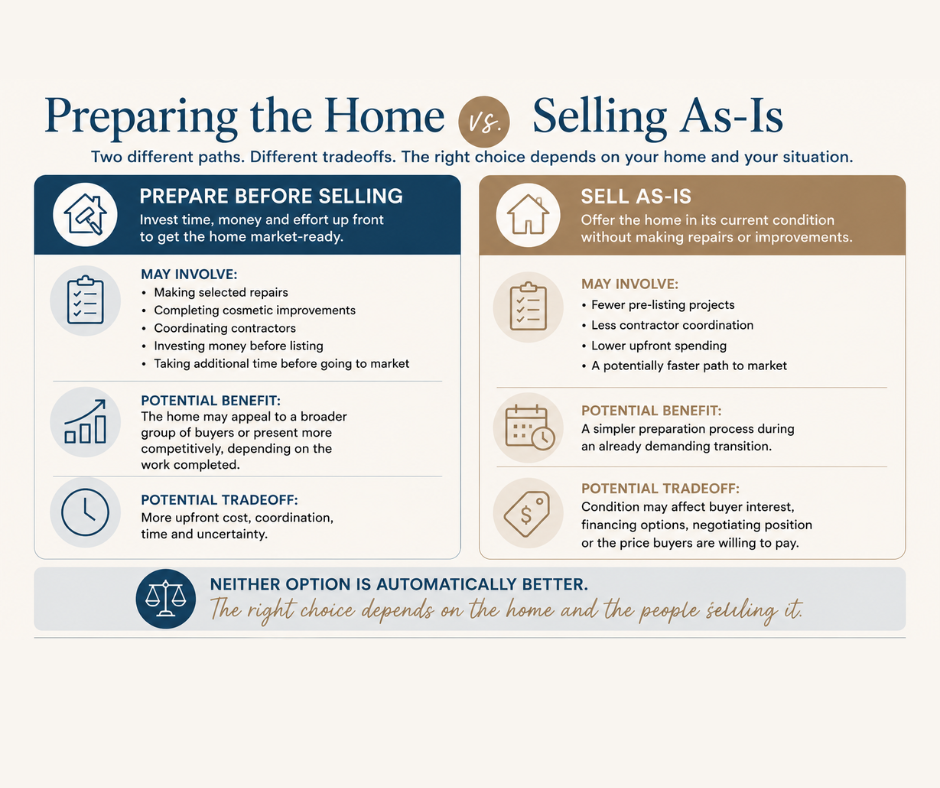
May involve:
Potential benefit:
The home may appeal to a broader group of buyers or present more competitively, depending on the work completed.
Potential tradeoff:
More upfront cost, coordination, time and uncertainty.
May involve:
Potential benefit:
A simpler preparation process during an already demanding transition.
Potential tradeoff:
Condition may affect buyer interest, financing options, negotiating position or the price buyers are willing to pay.
The right choice depends on the home and the people selling it.
Possibly.
Condition is one of many things buyers consider when deciding what they’re willing to pay.
A buyer who knows they’ll need to replace flooring, update a kitchen or make repairs may factor those costs—and the inconvenience of doing the work—into their offer.
But this is where the math needs more context.
Imagine spending money and several weeks completing projects before listing.
The important question isn’t simply whether the house could then sell for more.
It’s whether the additional return is likely to justify what you spent and what it required from you.
A higher sale price doesn’t automatically mean a better overall outcome.
Often, yes—but the condition of the property can matter.
Different loan programs and lenders may have property-condition requirements.
Certain issues can create complications for particular types of financing, even when both buyer and seller are otherwise comfortable with the home’s condition.
That doesn’t necessarily mean the issue must be repaired.
It may mean we need to understand how the home’s condition could affect the pool of potential buyers and factor that into the selling strategy.
This is where the wording of the contract becomes particularly important.
An as-is transaction does not automatically mean that a buyer won’t inspect the property or that nothing can happen as a result of an inspection.
The rights and obligations of both parties depend on the contract they sign.
We’ll help you understand the real estate side of the transaction and what the offer says before you agree to it.
When legal questions arise, an attorney is the appropriate person to provide legal advice.
Not the imaginary version where everything gets renovated perfectly.
What work would you actually be willing and able to complete?
Include both obvious project costs and smaller expenses that accumulate.
And what happens if the work takes longer than expected?
This becomes particularly important if family members live out of town.
Would it meaningfully expand the likely buyer pool or improve how the home competes?
Convenience isn’t worthless just because it doesn’t appear as a line item on a closing statement.
There is a lot of room in between.
The right strategy might be:
Fix one or two important things.
Skip the major updates.
Clean and simplify the home.
Address basic exterior maintenance.
Then sell it in its otherwise current condition.
An as-is conversation doesn’t have to be all or nothing.

Ask yourself:
Are there significant repairs or updates we’re considering?
What would they realistically cost?
Who would have to coordinate the work?
Would completing them delay the sale?
How might the work change the likely selling outcome?
Would the home’s current condition affect certain buyers or financing?
How important is simplifying the process to us right now?
Have we had someone evaluate the home before deciding?
If you’re unsure about several of these, that’s exactly why it’s worth having a conversation before choosing a strategy.
You don’t need to decide whether to sell as-is before Jana sees the property.
In fact, we’d rather you didn’t.
Let her see the house as it is.
Talk about the condition.
Talk about your timeline.
Talk about who’s managing the transition.
Talk about what you’re willing to take on—and what you’re not.
Then you can compare the options with actual context instead of assuming that you either need to renovate everything or sell the house exactly as it sits.
It’s to choose the option that makes the most sense for you.
What Do We Do With Everything in the House?
Start with the belongings without making “empty the entire house” your first goal.
Should We Make Repairs Before Selling?
Learn how to separate worthwhile repairs from projects you may not need.
Selling a Parent’s Home From Out of Town
Learn how to manage the property and home sale when you don’t live nearby.
You don’t need to prepare the property before you call.
And you don’t need to decide whether an as-is sale is right for you on your own.
We’ll look at the home, listen to what’s happening, and help you understand the options so you can make a decision that fits the property, your priorities and the transition you’re managing.
No pressure to list. No expectation that the house is ready.
Just practical guidance about what might make sense next.