
Where to start, what to consider, and how to make the home part of the transition more manageable.
When a move to assisted living also means deciding what happens to a longtime home, the number of decisions can feel enormous.
You don’t have to make them all today.
And you don’t have to get the house “ready” before asking for help.
This guide will walk you through the major things to consider—from belongings and property maintenance to repairs and selling options—so you can focus on what actually needs your attention now and take the rest one step at a time.

When there’s an entire home to deal with, it’s tempting to immediately start sorting closets, calling contractors and making lists.
But the first priority is the person who’s moving.
Before worrying about preparing the house for sale, get as much clarity as you can about the move itself.
When is the move happening?
A move that’s six months away creates different options than one happening next week.
What will the new living space be like?
Knowing its size and what’s already provided can help determine which furniture and belongings should make the move.
What does the homeowner want to bring?
Favorite furniture, photographs, artwork and familiar everyday items can help make the new residence feel like home.
Who is helping with the transition?
Identify family members, friends or others who will be involved.
What does the homeowner need most right now?
Sometimes the house can wait.
Getting settled comfortably and safely comes first.
You don’t have to solve the entire old house before you can begin creating the new home.
If you’re helping a parent or loved one, you may naturally become the person coordinating the transition.
But coordinating everything and having legal authority to make decisions about the property aren’t necessarily the same thing.
Early in the process, clarify:
If there are questions about ownership or legal authority, an attorney or other appropriate professional can help clarify them.
You don’t want to reach the point where you’re ready to sell only to discover there’s an unanswered question about who can actually make or sign for a decision.
A longtime home can hold an extraordinary amount of life.
Furniture.
Family photographs.
Important paperwork.
Dishes.
Tools.
Holiday decorations.
Clothing.
Collections.
Things tucked into closets that nobody has thought about in 20 years.
Looking at all of it at once can make the entire transition feel impossible.
So don’t start with everything.
1. What is moving with the homeowner?
2. What is important or irreplaceable?
3. What would family members like to keep?
4. What can safely wait until later?
Once those things are identified, it becomes easier to think about what might eventually be sold, donated, stored or removed.
And importantly:
Before making a complete clean-out your first major project, understand what actually needs to happen with the home.
Longtime homeowners know every imperfection in their house.
The old carpet.
The dated kitchen.
The room that hasn’t been painted in years.
The railing that’s a little loose.
The bathroom that could use updating.
It’s very easy to turn all of those observations into a renovation list.
But not everything you notice needs to become a project.
Before spending money, it helps to distinguish between:
Things that may involve function, damage, deterioration or safety.
and
Things that are older or stylistically dated but may still function perfectly well.
Then comes the more important question:
Which of those things actually matters enough to address before selling?
The answer depends on the home, the market, the likely buyers, the cost of the work, your timeline and how much you’re willing or able to coordinate.
Once the homeowner moves, everyone’s attention understandably shifts toward helping them settle into their new residence.
But the old house doesn’t stop needing attention.
If it will sit vacant for any period of time, make a plan for things like:
If the home becomes vacant or will be unoccupied for an extended period, contact the insurance provider and explain the change in occupancy.
Coverage requirements can vary, so it’s important to understand what applies to that particular policy and property.
A vacant home in Greater Peoria in July has very different needs from a vacant home in January.
The goal is simply to make sure someone knows who is responsible for the property until ownership changes.
A home transition can involve people you never expected to need.
Depending on the situation, that might include:
Movers
For belongings going to the new residence or to family.
Estate sale or auction professionals
For household contents that may have resale value.
Donation organizations
For usable belongings that aren’t making the move.
Clean-out or hauling services
For what remains afterward.
Contractors or handymen
If particular repairs make sense.
Cleaning services
For preparing the property after belongings are removed.
Lawn or snow services
For maintaining a vacant property.
Attorneys, financial professionals or tax professionals
When questions extend beyond the real estate transaction.
You may need very few.
You don’t have to figure that out first.
Jana has spent more than 20 years working in Greater Peoria real estate and has developed relationships with local professionals and service providers.
When a need comes up, she can help point you toward resources that may be able to help.
For adult children who live outside Greater Peoria, every task can feel more complicated.
Who lets someone into the house?
Who checks on the property?
Do you need to come back every time something happens?
Who takes care of the lawn?
How do you coordinate repairs?
What happens once the home is listed?
Many parts of a real estate transaction can be communicated and coordinated remotely, while local professionals handle tasks that physically need to happen at the property.
One of the most helpful things you can do early is separate:
The decisions you need to make
from
The tasks someone local can handle.
That can turn an overwhelming list into something much more manageable.
This may be the most important concept in this entire guide.
Preparing a home for sale isn’t necessarily an all-or-nothing decision.
You don’t automatically have to renovate an older home.
And deciding against a renovation doesn’t mean nothing can be done.
The right strategy might be:
Repair one important issue.
Skip the cosmetic remodel.
Remove some belongings but leave useful furniture.
Clean the home.
Tidy the exterior.
Then sell it in its otherwise current condition.
Or the right strategy for another property might look completely different.
It’s figuring out the right amount of preparation for this home and this situation.
Your time matters.
Your money matters.
Your energy matters.
And during a major life transition, those things deserve to be considered alongside the potential sale price.
Selling the home in its current condition may be an option.
For some families, reducing the number of projects they need to coordinate has significant value.
But “as-is” is worth understanding before you decide.
It doesn’t automatically mean:
Condition may affect pricing, buyer interest, financing and negotiations, so the decision should be made with the particular home and market in mind.
It’s one possible strategy.
A common assumption is:
“We’ll call a Realtor once we get the house ready.”
For this kind of transition, we’d rather you call before then.
Not because we’re trying to rush you into selling.
Because a conversation early in the process may help you avoid doing things that aren’t necessary.
Before you:
…let Jana see the home.
That’s part of what she’s there to help you figure out.
When the time does come to sell, the process begins looking more like a traditional home sale.
The details will vary, but generally you’ll work through:
We’ll look at the home, comparable properties, current competition and what’s happening in the Greater Peoria market.
Pricing should reflect the property, its condition, the market and your goals.
We’ll identify what needs to happen before photographs and showings—and what doesn’t.
The Heffron Group will develop and execute the marketing strategy for the property.
We’ll establish how access to the property will work and keep you informed about activity.
We’ll help you understand the terms, contingencies and considerations involved so you can make an informed decision.
If inspections or other issues arise, we’ll help you understand what’s being requested and your real estate options.
We’ll help keep the transaction moving toward closing and communicate what you need to know along the way.
That’s our job.
This isn’t a list you have to finish before calling us.
It’s a tool to help you see what may eventually need attention—and to remind you that not everything needs to happen at once.
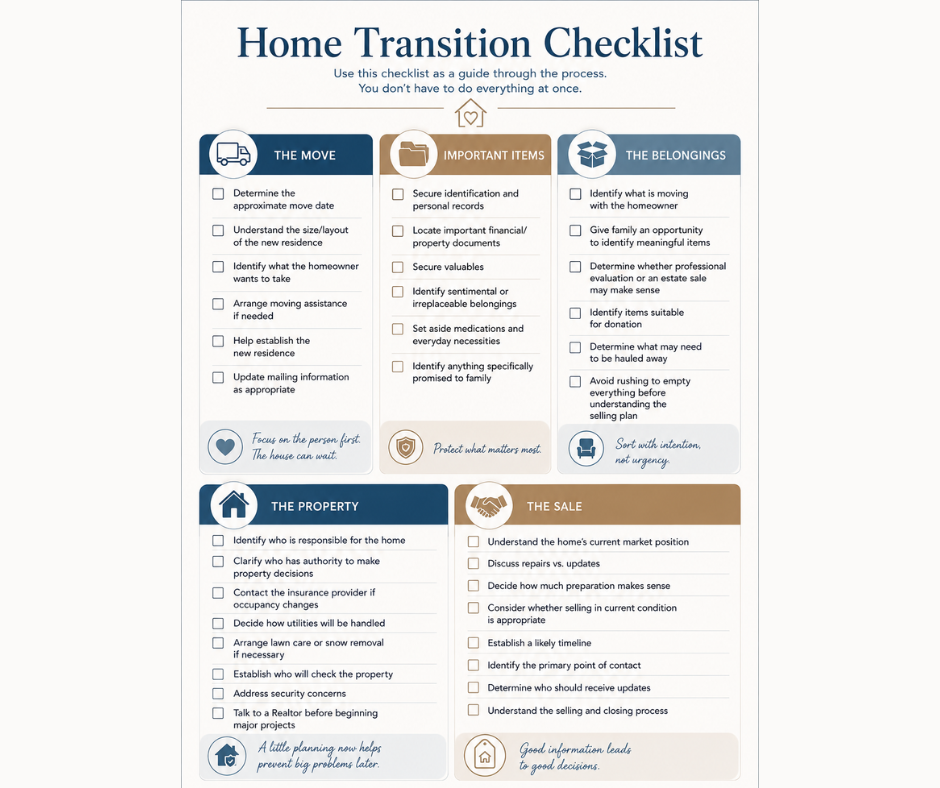
A practical starting point for handling furniture, keepsakes, family belongings, donations, estate sales and clean-out decisions.
Learn how to distinguish repairs from updates and decide where your time and money may actually be worth spending.
Learn how to manage the property and real estate process when you don’t live in Greater Peoria.
Understand what selling as-is means, what it doesn’t mean and the tradeoffs to consider before deciding.
For more than 20 years, Jana Heffron has helped Greater Peoria homeowners navigate real estate decisions through all kinds of life changes.
Experience teaches you more than how to list a house.
It teaches you to listen.
To recognize the questions someone hasn’t thought to ask yet.
To know when something really needs attention—and when it probably doesn’t.
And to know which local resources may be able to help when something falls outside the real estate transaction.

Maybe the move is months away.
Maybe it happens next week.
Maybe your parent has already moved and you’re standing in a house full of belongings wondering what on earth you’re supposed to do now.
You can call us from any of those places.
You don’t have to empty the house first.
You don’t have to make the repairs first.
You don’t have to find all the right service providers first.
And you don’t have to decide whether you’re ready to sell.
Tell us what’s happening.
We’ll start there.
No pressure to list. No expectation that the house is ready.
Just a conversation about what’s happening and how we may be able to help.